

Is it better to be a consistently good team or an occasionally brilliant one? We’ll find out by the end of Australia’s European tour. But now, after a 26–19 loss to Italy in Udine – their second defeat in as many matches on this crucial trip – the answer seems obvious. Because despite the Wallabies’ flashes of brilliance throughout the Joe Schmidt era, their inability to deliver steadily could yet prove costly.
At present, the Wallabies are ranked seventh on World Rugby’s charts. If that doesn’t change, the hosts of the 2027 World Cup will be drawn alongside one of the top six teams in the group phase. Even if they progress, Australia would likely face another stiff challenge at the first knockout stage. That’s not the kind of jeopardy a rugby nation of this pedigree should be flirting with.
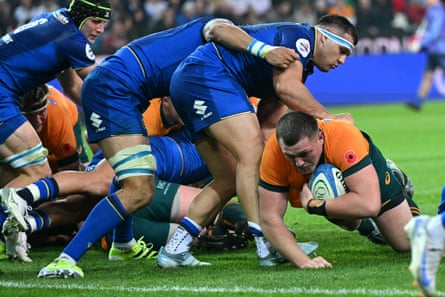
Against Italy they were neither great nor dreadful. They bagged two tries through front-rowers in the first half – Matt Faessler and Angus Bell burrowing over from close range – and largely rectified their sloppiness under the high ball that they showed against England. But the game was a microcosm of their broader malaise: moments of energy offset by costly lapses.
The most tangible of those came just before half-time, when Taniela Tupou collected a pass on the gallop, skipped around a defender, rode another challenge and surged forward. The Wallabies were on the front foot and looking to orchestrate something from unstructured play. Then, inexplicably, the ball spilled forward. Italy countered. The danger passed when Australia won a penalty on the floor soon after, but the sense of frustration lingered. They led 12–9 at the break after 40 minutes of hard graft, but the feeling was of something half-finished, a tune played out of key.
That mood hardened midway through the second half. With Italy leading after Monty Ioane’s try, Australia pressed again. They pounded the line on 68 minutes, phase after phase, bodies piling in. But they were held up over the line; another chance gone. It was the story of the night: plenty of possession, little incision, and no spark of invention beyond one-up runners and short passes around the corner.
after newsletter promotion
When full-time came, it was difficult to know exactly what to make of it. Australia had competed. They had shown intent. But they had not convinced. The outlines of a proper team are there – an improving set-piece, improved defensive structure, a handful of genuine match-winners – yet the brushstrokes remain uneven.
Schmidt has clearly given the Wallabies a plan, but plans need execution, and execution requires habit. The best teams make the extraordinary seem routine; the Wallabies too often make the routine look extraordinary.
So, is it better to be consistently good or occasionally brilliant? Australia remain trapped somewhere in between, capable of beauty, vulnerable to chaos, and still searching for the kind of steady excellence that turns potential into power. Until they find that rhythm, they’ll remain a team of flashes, not finishes.
About the Author