

Maybe you missed Warwickshire’s one-day cup game against Sussex in the dog days of August. It was a group fixture between two mid‑table teams in a competition to which no one pays a lot of attention. But despite it all, the match marked a significant little milestone in the modern history of English cricket. Because Sussex gave a debut to a 21‑year‑old from Hemel Hempstead called Troy Henry, the first male player to come up into professional cricket through the Ace programme.
Henry had turned up for the very first trial Ace held, back when he was a teenage left‑arm quick who dreamed of playing pro cricket and needed help to do it. Five years later, Sussex sent him in at No 9, he made 15 off eight balls, then came on fourth change and took one for 34 in four overs of left‑arm spin, because Ace’s coaches had persuaded him that if he wanted to get ahead he ought to switch disciplines.
Four days later another Ace graduate, the 17-year-old Davina Perrin, smacked 101 off 43 balls for Northern Superchargers in the Hundred eliminator against London Spirit, in one of the stop‑and-watch-this moments of the English summer. A month earlier a third Ace graduate, Amy Wheeler, signed a new one‑year contract with the Blaze.
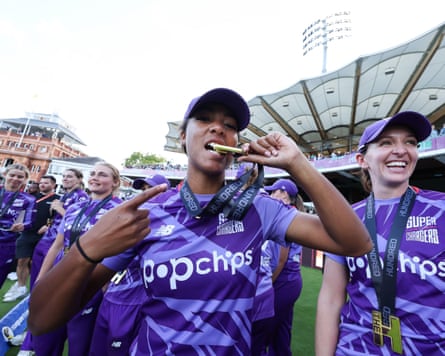
Looking back on what she has learned, Rainford-Brent says she was surprised at “how much support the young people needed”. She imagined Ace would be primarily about improving performance – she is so easy-going, it’s easy to forget that she was a remarkable athlete herself – but the array of challenges young players face is much broader than she imagined. Take their three professionals. Perrin already had talent but needed personal mentoring, Wheeler’s family needed more structural support, and Henry needed specific coaching to help him make the switch from bowling pace to spin.
She is not done. “Our No 1 goal was to produce 10 professionals by 2030,” and they are well on their way already. “I think the wider target now is about creating that wraparound support, so we are creating employability in the game even for people who don’t make it as professional players.”
after newsletter promotion
The two biggest steps she wants English cricket to take are to bring in more means testing so the cost of entry drops for people who are being priced out of playing, and changing the structure of the talent ID system so that opportunities are distributed evenly around the country rather than focused on, say, a handful of private schools.
All this has to be done even when the conversation has moved on. The Independent Commission for Equity in Cricket published its exhaustive report on the state of the game in 2023 but already it feels like a document from another time. “You get these peak interest moments and then it can fall off,” Rainford-Brent says. “Our true test is what happens in five or 10 years’ time and what we did in between these cycles when everyone was paying attention.” It helps that the leadership at the England and Wales Cricket Board has changed for the better, not least because, improbable as it seems to her, Rainford-Brent is a board member herself. “And yes,” she says, “I do wear my hi-tops to the board meetings.”
“What I say is that we’ve gone from being hopeless to hopeful,” she says. “But hopeful doesn’t mean we’ve cracked it.”
About the Author